Simon Sinek said ‘Start with the Why.’ so here we go. Why Belonging, why The Belonging Collective, Why a blog? All very good and valid questions.
It seems that Belonging is on every presentation I attend currently, whether it is on behaviour, attendance, educational engagement or special educational needs.
In one of her final speeches as HMCI, Amanda Spielman referenced the power of Belonging in helping to mend the social contract that exists between schools and their community.
‘I’ve regularly raised concerns about the damage the pandemic has done to the social contract. To the clear expectation that parents should get their children to school every day and that in return, schools do everything they can to give children education and to prepare them for their future. Making sure schools are a place where children feel they belong is vital to rebuilding that contract and to their learning and development.’ Amanda Spielman.
The Education Endowment Fund sub-titled their Supporting School Attendance resource, “Build a culture of community and belonging for pupils,” stating that, “absences or internal truancy may be caused by pupils not feeling they fully ‘belong’ in the school.“
The Confederation of Schools Trust 2023 Conference ran on the theme of Belonging, not just for students, but for staff, describing it as “pivotal to engaging a drive towards a shared mission.“
One of the key positive elements of practice, from the Ofsted report ‘Good decisions: children with complex needs in children’s homes’ from January 2024, that resulted in good experiences for children was “facilitating a sense of belonging for children, where they know that staff would not give up on them and that this is their long-term home.”
It is literally on the tongue of every educational professional speaking or presenting on any element of good practice and yet, it remains a slightly obscure, ambiguous and enigmatic concept.
Most schools will tell you they do this well. Most headteachers genuinely believe that pupils feel that they belong in their school, that children thrive and flourish thanks to the hard work and dedication of their staff in making connections and forging relationships with students and yet, often in the same conversation, we will talk about disadvantaged and ‘hard to reach’ families. Surely belonging trumps disadvantage? Surely no-one who truly feels like they belong would be ‘hard to reach’?
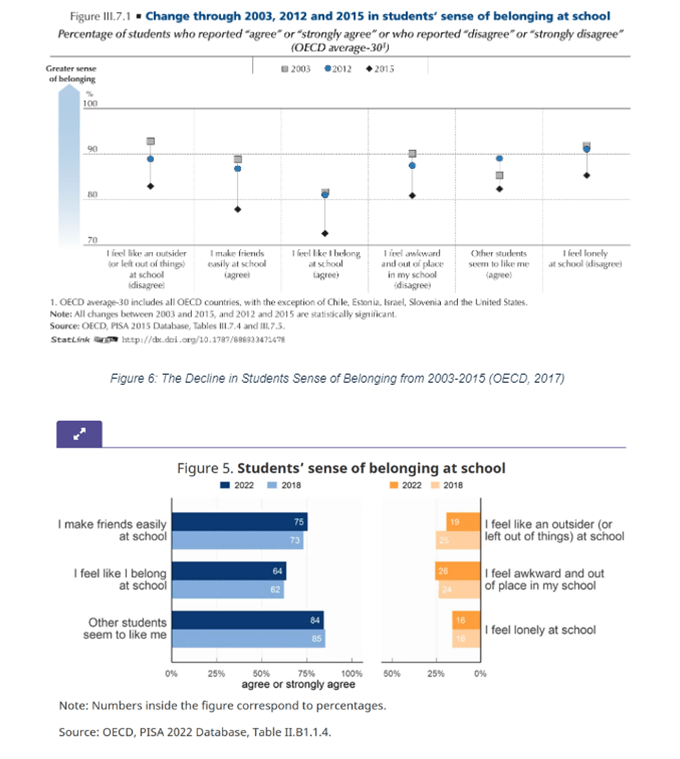
At the same time, if we look at the OECD PISA data on Belonging, we can see that it has steadily declined globally, other than in a small handful of countries, and that feelings of belonging are reportedly worse for disadvantaged students.
The UK sits below the OECD average in all measures.
This has led me to read a lot around the topic of belonging, what it really means, what does it look like? How does it feel? Does it really have the impact it is purported to have? Is it the educational silver bullet, or just another snake oil for school leaders to chase on their search for the best opportunities for their students?
This blog is a way of sharing this reading, looking for others to participate, contribute and comment on their own research or experience. PISA data shows this to be a global issue and there is much to be learned from the research going on around the world informing this debate. Hence, The Collective.
I hope that this blog will help to explore the potentially powerful impact of belonging, how we can measure it, how we can harness it and how we can ensure that it is felt by every student in our care, not just those who find it easier to conform to our pre defined ‘normal.’
I sincerely hope you will join me on this journey.

 The Belonging Collective