In my last blog, I talked about using a language of Love over Respect and Tolerance. Since then, I have been reflecting on the language of belonging in a more general sense.
In schools, and life, every interaction we have, and the language we use to frame that interaction, has an impact on our feeling of belonging. If we use language deliberately, we can greatly enhance our positive relationships with students and therefore engender a greater feeling of belonging.
I was fortunate recently to be able to visit Reach Academy Feltham and take a tour of the school with two inspirational leaders, Headteacher Tilly Browne and Deputy Headteacher Harpreet Dhillon. On my tour, it was great to see the learning and curriculum development that has taken place in the school but what I was struck by most, was culture. The school has worked exceptionally hard and deliberately to embed a positive, relational culture throughout every aspect, and this is specifically taught to staff. One of the most notable uses of language to embed this, was referring to classes as teams. This language was consistent, at all times. “Team, what do we do now?” “Well done team, great work!” “Come on team, we can do better than this.”

This is a deliberate choice of language that bonds. Every child is part of the team, every child contributes, every child is supported, every child belongs.
In his excellent book, “No Outsiders,” Andrew Moffat talks about the language “Tolerate, Celebrate, Accept.” and how he has moved between the three as his understanding of inclusion has developed. How he moved away from talking about tolerating, as it sounded like ‘putting up with‘ into talking about ‘celebrating.’ After reflecting on feedback however, he recognised that ‘celebrating‘ was not the right word either. We do not celebrate all of our differences, there wouldn’t be enough time in the day! We can celebrate living in a diverse community, but to say that we celebrate each individual difference would lack validity. He also reflects on how it might be wrong to expect people of strong belief to “celebrate” the differences of others. So, he has opted for the language of ‘acceptance.’ We can accept the differences of others, without compromising our own beliefs or culture. This whole chapter is a really interesting reflection on how language shapes culture and practice.
I was struck by a post on Linked In recently from Michael Chiles, Headteacher at Longendale High school. In it, he shared the key, consistent phrases that underpin their daily routines, being clear that school culture is ‘taught, not caught.’ You can see the full list of phrases in the image below, but the one that stood out to me was, “It’s about building your legacy.” What a great phrase to ensure children are thinking about their lasting impact on the school community.
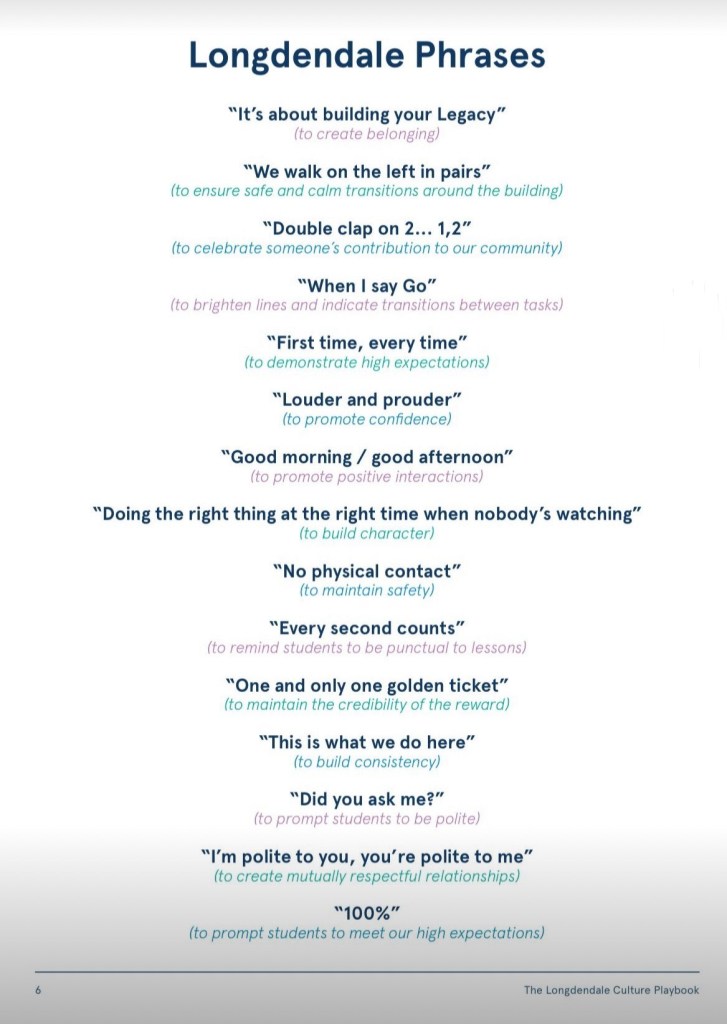
Similarly to Reach Feltham, the strength of this is in the consistency of application. The school is clearly communicating an expectation to staff on the way they communicate with children in order to embed school culture.
So, what sort of language engenders belonging?
Greetings.
The way that we greet each other in school is the foremost way in which we can establish connection and significance. Greetings should always be polite, friendly and mindful of the individual. Most of all, remember names. Names are vital to connection. If you can’t remember my name, I know I am not significant to you. This video below, which circulated heavily a few years ago, shows an amazing way of greeting and interacting with nursery students at the door, whilst respecting their personal choice. (click on the image to go to the video. Various versions of this exist now, I am not sure of the origins… I don’t know who Mrs Judy is, but she is a genius and I would imagine every child in her class felt a strong sense of belonging!)
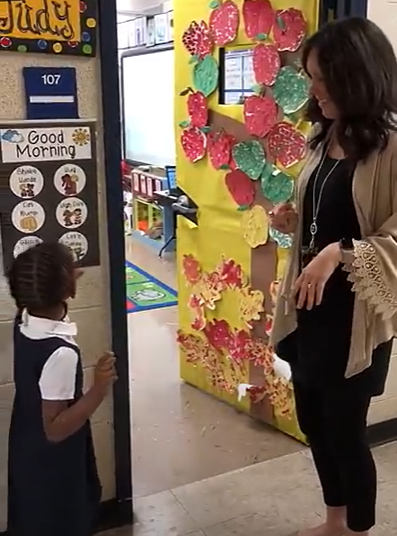
Greeting should be personal to hold significance, so a school standard phrase is probably not appropriate, but a culture of greeting students with warmth and by name should be an expectation.
Classroom Belonging
I would strongly advocate the Reach Feltham strategy of team. Referring to the class as a team is a terminology that ensures inclusion and significance when used consistently. One of my brilliant small schools, St Teath refers to the whole school as #teamteath! A slogan emblazoned on their hoodies. Each child has a place in the team, a contribution to make and a skill to bring.
Share success and failure equally in the classroom. Phrases such as “Where have we gone wrong here?” or “How can we make this even better?” help to us to frames errors or mistakes as a collective responsibility, not an individual one. Talk often about team performance and expectations and share in the successes and failures of the team as a whole, not the individual.
Owning Mistakes.
Getting things wrong is how we get things right. Making mistakes is to be celebrated. Phrases in the classroom such as “Amazing mistake!” or ” What’s the next step on our journey to success?” help students to see learning as a journey in which getting things wrong is essential. If we get everything right, we learn nothing. If we focus on success, our less academically natural students will feel that the classroom is not a place where they belong, a place where they can thrive. Celebrate “A Pivotal Mistake” or “Misunderstanding of the day.” Not only will this refocus attention on the learning but help others to see the power in getting things wrong.
In his book The Culture Code, Daniel Coyle tells of a research project in Stanford, Yale and Columbia in which different types of feedback were analysed. They discovered that one piece of feedback boosted student effort and student performance so immensely that they labelled it “magical feedback”. it was not complicated. it consisted of one simple phrase, “I’m giving you these comments because I have very high expectations of you and I know that you can reach them.” these words deliver a whole host of belonging cues.
- You are part of this group
- This group is special; we have high standards here.
- I believe you can reach those standards.
They communicate that this is a safe place in which you can give your best effort.
Exploring Difference.
When we are learning about other religions, countries or cultures, do so through the eyes of an individual. Try not to talk about difference in groups. De-personalising difference is one way in which radicalisation is able to cultivate fear and popularise untruths. As Brene Brown says in her book, Braving the Wilderness, It’s hard to hate people close up. Get close to stories of difference. Personalise them and explore them with an inquisitive mind. Encourage children to ask questions about the individual. “I wonder if Sami celebrates Christmas?” “Do you think Benji goes to a school like me?”
Dealing with Behaviour.
It is useful to have some stock phrases when dealing with behaviour that falls below the expected standard of the school, but the key is to ensure that expectations are applied consistently and fairly by staff. Phrases that do not connect the behaviour to the individual are helpful in allowing the child to see that the behaviour does not define them. Some examples would be: “That is not how I am used to seeing you behave.” or “Why are you behaving so uncharacteristically today?” help the child to disown the behaviour, whilst also accepting a level of responsibility.
Using phrases that put you alongside the child will strengthen the feeling of belonging. “How can we put this right?” What can we do to make sure this doesn’t happen again?” and phrases that demonstrate personal, emotional connection help a child to see their significance to you, “It hurts me when I see you like this.” or “When you’re angry it makes me sad inside.“
Again, one of the Reach Feltham ‘Expert Habits’ is useful here. “Praise Loud, Fix Soft.” to narrate compliance as the social norm. By making sure that the need for correction is less public, it helps to ensure that behaviour correction is not ‘associated’ with an individual, allowing them to reflect and act upon feedback without the contribution of others.
Welcoming new additions.
When you have a new addition to the classroom, securing belonging quickly and effectively is vital to their engagement and quickly de-escalates anxiety. Using phrases such as, “How are we going to help Beau to get to know the nameofschool routines quickly today.” Helps to reinforce the sense of routine ownership for the whole class, as well as inform Beau that they are part of something. Using phrases with the new student that affirm their new status as part of the school/ class will also be effective at securing significance. “Now that you are part of Crimson Class Beau, you need to know how we leave the classroom. We always leave using the following routine….” Extra time invested in the first day will pay huge dividends in the days to come.
In Summary.
Belonging is not something else for us to do, it is everything we do. Use language deliberately to establish and maintain relationships. Use the collective language of us, we, team to establish shared ownership, and value the contribution of the individual to establish significance. A strong sense of belonging is earned over months, but lost in seconds. Choose your language carefully and be the first to apologise when you get it wrong.

 The Belonging Collective