WHAT DID PETER DRUCKER NEVER ACTUALLY SAY?
‘Culture eats strategy for breakfast.’ Peter Drucker (possibly, but probably not, more likely Steve Jobs or Jack Welch
That is to say, belonging matters just as much in business as it does in education. Human beings need to belong, they need to find significance and they need to feel safe. Safe to take risks, safe to innovate and safe to be honest. Belonging is the key that will superpower any business.
Research by Better Up found that when employees feel like they belong there’s a 56% improvement in job performance, 50% lower employee turnover and 75% fewer sick days. For a 10,000 person company that would result in an annual saving of over $52 million. So there are some really good reasons to focus on belonging in order to improve your business peformance.
In 2012, Google undertook research into every aspect of their teams. They studied their gender, hobbies, education, personalities and skills, interactions, project duration and difficulty. Project Aristotle sought to establish what factors built effective teams. What they found was that the members who constituted the teams and their skillset was not important. The key to the success of the team, was the social bonds they formed in the execution of their work. What mattered was the psychological safety of the individuals in carrying out their work and the dependability they had on each other. Those teams who ate together and were happy to talk about their personal lives with each other, successes, failures, worries and concerns, formed the optimum teams and achieved the most success in their projects. Googles research taught them that a tightly bonded team of average performers could achieve things that no superstar could, in ways that no one had even thought of. Google even harnessed the power of this discovery through the formation of a checklist in how two run a meeting the ‘Google’ way:
- Don’t interrupt your team mates.
- Summarise what people are saying so that they know you are listening.
- Say when you ‘don’t know.’
- Don’t end a meeting before everyone has spoken.
- Encourage people to share their frustrations with the team.
- Call out conflict when you see it and try to resolve it through an open discussion with the team.
In his book Centennials, Alex Hill explores the 12 key habits that have helped enduring organisations to achieve success and key amongst these is listed ‘Breaking Bread.’ that is to say that successful organisations find ways for their teams to eat together. Burberry, Facebook, Google and Pret A Manger all provide free hot and cold food in their cafes every day. Apple has 7 large cafes in their offices, Google has 170 small cafes, at Eton, students always dine together. All to encourage staff to socialise over their food rather than eat in isolation at their desk. Why? Hill explains through the research of Professor Dunbar that those who eat together socially, feel happier, are more satisfied with life, are more trusting of others , are more engaged with their community and have more friends that they can depend on. The act of eating together triggers the release of endorphins, chemicals that create a sense of bonding amongst humans and primates and helps reduce stress, pain and induce an overall sense of wellbeing. So taking time together at lunch can supercharge your team to achieve more and be much more effective than by taking a quick lunch on your own in the park or, even worse, never leaving your desk!
An interesting and corelating piece of research was carried out by Thomas Allen during the cold war. (as explained in Daniel Coyle’s brilliant book, ‘The Culture Code.’) he was employed by the US Government to explore why some projects were successful and others weren’t. The answer?….the proximity of their desks. What mattered most in successful teams was not intelligence or experience of team members, but how closely their desks were located. The closer the desks, the more frequent the interactions, as show in the Allen Curve below, and the more frequent the interactions, the more successful the project. Nothing more complex than that. But what is most interesting, is the steep decline of the curve from 8m. Any more than 8m, or even a different room or floor in the same building, and you may as well be in a different country as far as interaction goes. Even more interestingly, digital communications follow the same pattern. We are 4 times more likely to email people who share our location and as a result, complete projects 32% faster.
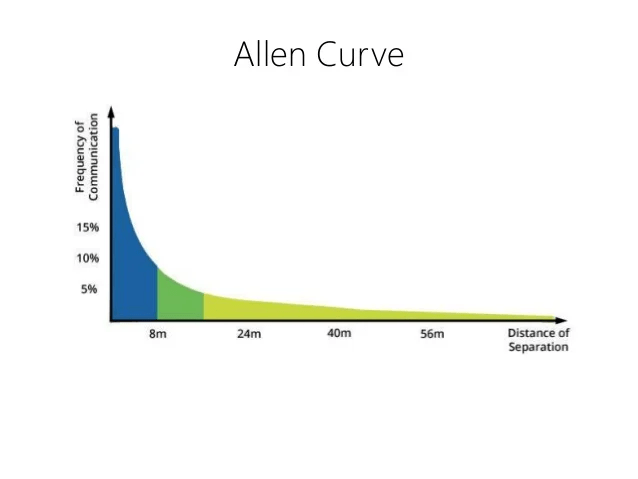
Coyle explains that the Allen curve follows evolutionary logic. In human history, close proximity is an indicator of belonging. We get close to people when it is mutually safe to do so. The best conversations and collaboration happen when we get close up. There is a reason that café tables are 60cm wide….the distance Hill asserts is optimum for a fruitful conversation to take place.
One of the other key findings of Google’s research was that, in order to make a team more effective, members needed to feel that they made an impact. Seth Godin explores that further in his research, ‘The Song of Significance’ finding that significance is what motivates us to do the work that can’t be automated, mechanised or outsourced. Individuals need to feel significant to the organisation in which they work. This can be further defined as feeling valued, important, that you make a difference, that people would notice if you didn’t show up. Significance is a key to feeling a sense of belonging. Significance is the reason you are important to your team, the reason you work hard. Cohen, in his book ‘Belonging’ shares that one of the biggest threats to this feeling of significance at work, is discrimination, both conscious and unconscious and, as a result, one of the most effective methods of securing the significance of the individual at work, is well researched and executed diversity training. Training that ensures all employees are seen, valued and represented in the work place, nurturing connections and empowering the individual.
In his leadership fable “The Five Dysfunctions of a Team‘ Lencioni lists the first dysfunction as, the Absence of Trust. This, he proposes, is down to team members unwillingness to be open with each other, to show their weakness or vulnerability. Trust builds belonging.
He goes on to state that members of trusting teams:
- Admit weaknesses and mistakes.
- Ask for help.
- Accept questions and input about their areas of responsibility.
- Give one another the benefit of the doubt before arriving at a negative conclusion.
- Take risks in offering feedback and assistance.
- Appreciate and tap into one another’s skills and experiences.
- Focus time and energy on important issues, not politics.
- Offer and accept apologies without hesitation.
- Look forward to meetings and other opportunities to work as a group.
He suggest that the best ways to overcome this dysfunction are for teams to:
- Share personal histories.
- Be honest about what each team member contributes to the team and offer one way in which they could improve for the good of the team.
- Team profiling.
- 360 degree feedback.
- Experimental team building exercises.
McKenna and Maister assert that ‘ failure in building trust is rarely a result of poor ethics or bad intentions, rather trust is too often destroyed by thoughtless behaviours‘ and so organisations need to proactively build structures and systems that positively reinforce trust in order to ensure the psychological safety of its employees that will, in turn, foster belonging.
In 2024, Forbes published the work of Kelley Primus on the importance of belonging in business. This research encourages employers to shift from a ‘business first’ mindset, to a ‘people first’ mindset and that, in doing so, business performance will naturally follow.
She uses the work of Rhodes Perry to explain how leaders can do this by developing these skills:
• Authentically Connecting With Team Members: Leaders should demonstrate empathy and humility.
• Building A Culture Of Trust: By utilizing effective communication and feedback structures that come from a place of deep listening, leaders can help develop an atmosphere of psychological safety for all.
• Instilling Accountability Across The Team: Everyone must take ownership for the results of the team’s work. This means demonstrating a willingness to accept mistakes and, rather than blame the individual, prioritize finding the solutions to fix the process.
• Recognizing Each Team Member’s Uniqueness: With a strong grasp of sonder, leaders can empower their teams’ autonomy and celebrate the different perspectives and skills they bring.
High quality performance management is one of the key ways in which we can ensure that team members feel their significance to the team and align with culture and context, instilling accountability and recognising unique talent. In Drucker’s book ‘Management,’ he states that, ‘in order for workers to achieve, they must therefore be able to take responsibility for their jobs. This requires: productive work; feedback information and continuous learning.’ These three requirements form the cornerstone of good performance management or appraisal.
Performance management can be defined as, ‘the continuous process of identifying, measuring and developing the performance of individuals and teams and aligning performance with the strategic goals of the organisation.’ (Aguinis, 2013)
In both of these definitions, we can see that the process is ongoing, or cyclical. In many institutions, performance management is an activity that is visited once a year, relating back to historic targets. Aguinis suggests that performance management should be an ongoing process that takes place constantly including several, inter-related components. All of these components should relate back to the organisations vision and mission. However, according to Senge, having an organisational vision is not enough, in order to create employee buy in and therefore organisational success, you must be able to develop shared vision. Shared visions are rooted in each individual’s personal visions and so a good performance management strategy will help to foster each employee’s personal vision around that of the organisation. (Senge, 1990)
Many employees can describe what they do and some can articulate how they do it, but very few know why they do it. (Sinek, 2011) Sinek argues that by engaging your employees in the why factor, you can help them to develop their personal vision linked to that of the wider organisations vision and goals.
Taylor identifies two main approaches to performance management. The first being the ‘standards oriented approach,’ where the focus is on ensuring compliance to specified standards of the organisation. This approach will see the clearly defined objectives and close monitoring of performance in direct relation to these.
The second approach is the ‘excellence orientated approach.’ Here the focus is on striving for excellence, continuous improvement and personal development. The emphasis in this method is on commitment rather than control. (Taylor, 2008)
It is possible to see both of these approaches used harmoniously, providing employees with a clear understanding of expectations, whilst also securing their buy in to an excellence culture and their own personal and professional development.
One of the key strategies advocated by Jacob, Unerman and Edwards for fostering a belonging culture in an organisation, is to ‘Lead from Every Seat.’ That is to say that everyone in any organisation takes responsibility from the culture. This means that the CEO cannot remain aloof from the strategy and neither can the lowest paid worker on the shop floor. Everyone needs to understand, buy in and live through it. In that way, an organisation can stay resilient to the external factors that may act upon it. For that to happen, the belonging strategy must be clear, well communicated and regularly revisited. Employees must see it as the core to the business, more important than any other element. Belonging is built in droplets, but lost in bucketloads, just like trust. When a manager steps outside the strategy, other employees will see it as fallacy and the gains are lost.
In summary, high performing organisations take deliberate and tangible steps in order to foster a strong sense of belonging in their employees and, in doing so, they secure the longevity and success of their business. This can be done through building trust, sharing vulnerability and communicating, through proximity, a shared vision of success and the part that every individual has in its achievement.


 The Belonging Collective