What does Belonging feel like for students and teachers?
Over the last term, I have been working with a group of colleagues across a city to talk about Belonging and how we might harness it as a superpower to generate enhanced outcomes both educationally and in terms of wellbeing for our young people. We know that Belonging is fundamental to the success of our students and staff, and our schools are doing some really exciting work, but we wanted to take this a step further. We have already done the research and assessed our best bets at improving this fundamental area of human development but, before jumping headlong into solutions, we wanted to hear from our key stakeholders and so, we carried out some extensive survey work across multiple schools, trusts and age ranges.
We chose to use Anthony Lawton and Insight Genie to help us with this work and have to say, they have absolutely delivered on the brief. Before I get in to an overview of our own findings, if you are looking for someone to help you with meaningful research and in-depth insight, I would highly recommend conversation with Anthony. Not only does his system make swift work of compiling, analysing and making sense of large data batches, his carefully refined knowledge base ensures that suggestions, strategy and advice are research based and within context.
Our intention was to ask open, wide ranging questions and allow our respondents to answer in full, flowing text, avoiding the potential for us to ask leading questions that pre-implied our expected response. We then used a mixture of AI and human interpretation to pull out the main themes from our respondents. I haven’t included a full methodology in this blog, this will be done in time.
In our initial exploration of data we have focused on exploring what supports generating a sense of belonging at both primary and secondary level, along with looking at the key barriers. We then focused on the key similarities and differences between student perceptions and those of their teachers.
Primary School
According to our respondents, primary school students feel a strong sense of belonging when they have supportive friendships and positive relationships with teachers. A safe and inclusive school environment, characterised by kindness and the absence of bullying, significantly contributes to their comfort and happiness. However, challenges like insufficient emotional support and lack of inclusive participation in activities exist, hindering their overall well-being.
Friendships and teacher relationships emerged as central themes in fostering belonging. The presence of friends who offer emotional comfort and teachers who promote a nurturing environment are critical to students feeling included and safe. Interestingly, students particularly value creative and interactive lessons, which enhance their engagement. The importance of cultural inclusion and respectful peer interactions was highlighted by primary students as being central to the building of belonging.
“I feel comfortable at school when my friends are there because it makes me feel happy and relaxed.”
“I feel comfortable and included at school when I have the chance to express my thoughts in creative lessons.”
Student belonging is intricately connected to personal experiences within the school environment. Teachers and school leaders highlight that when students feel recognised and valued as individuals, a stronger sense of belonging emerges. This is reinforced through understanding peer relationships, compassionate school staff, and inclusive policies. A welcoming greeting each day and acknowledging student achievements enhance these feelings of connection.
Classroom Culture: The environment within the classroom deeply influences a student’s sense of belonging. Teachers emphasise the importance of listening and responding to individual student needs and fostering inclusive dialogue.
“Acknowledging students’ contributions fosters a sense of individual value.”
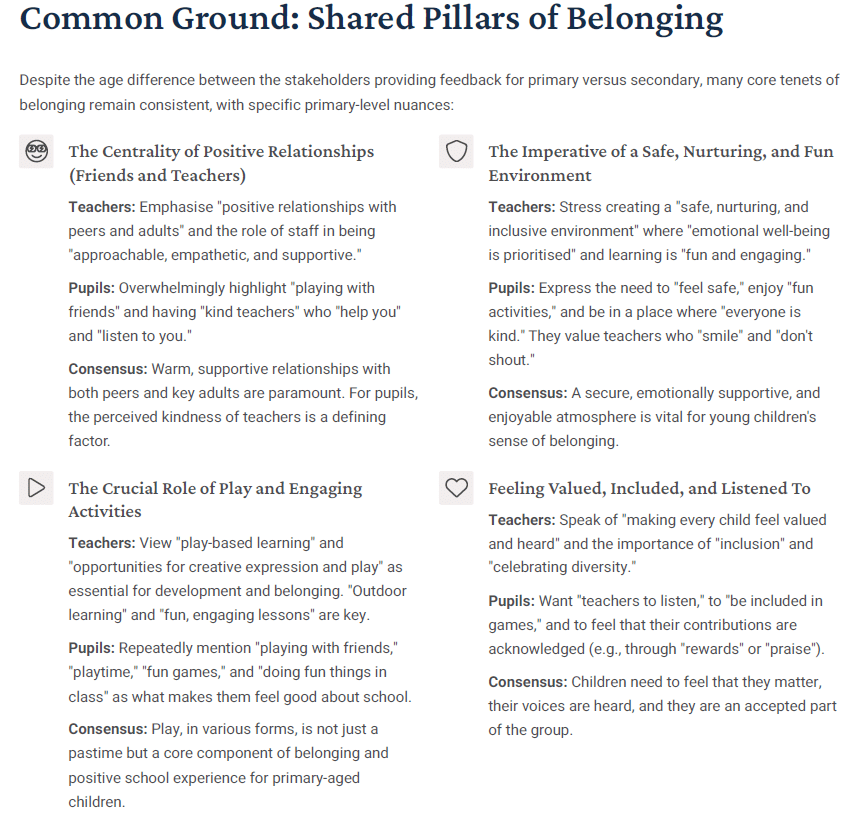
When we compare the responses of primary teachers and students, we see the following results:
It seems that one of the most significant challenges faced by primary school students in developing a strong sense of belonging is related to interpersonal conflicts and misunderstandings. These factors can create a sense of exclusion or alienation from the group atmosphere that is often pivotal to feeling accepted.
“When I feel uncomfortable when people are looking at me.”
Social Challenges:
The interactions students have with peers can greatly influence their sense of belonging. Instances such as bullying, social friction, and exclusion from groups are reported as significant barriers to developing a positive school environment.
“Sometimes when I try to talk to my friends they sometimes answer me but then when someone else comes up to them, they talk to them instead of me.”
“People saying rude stuff about me.”
School Structure and Engagement Gaps:
The organisational framework of a school, including its policies and engagement tactics, can sometimes inadvertently hinder a student’s sense of belonging. Certain systemic elements such as lesson formatting and lack of inclusive engagement opportunities may exacerbate feelings of isolation.
“Sometimes I feel like in meetings I’m not really included.”
“The expectations are too difficult.”
Perceptions of Fairness and Support:
The manner in which students perceive they are treated, including fairness of school rules and responsiveness to individual needs, has a profound impact on their belonging experience. Teachers’ actions and the apparent support they offer can influence a student’s perception significantly.
“When teachers ignore what I say or I feel excluded.”
“A lot of people go through times when they feel like they don’t fully belong, including me, it’s when the teachers and students don’t care what you’ve been through.”
“Sometimes I feel left alone when I don’t have anyone to play with.”
“I felt that when a lunch assistant said what happened between me and another boy in the school but when the boy was hitting me they did nothing.”
Secondary School
Secondary school students experience a multifaceted sense of belonging, primarily driven by friendships and the supportive presence of teachers. Key elements that enhance belonging include the presence of friends, inclusive school practices, and empathetic teachers. Conversely, students express discomfort when faced with bullying, strict enforcement of rules, or when they feel unsupported by the school staff. The inclusion of gender neutral facilities has been noted as a positive step towards inclusivity, promoting a sense of belonging among diverse student groups.
Friendships are essential, providing students with emotional security and a sense of community. Positive relationships with teachers who are approachable and supportive further enrich the feeling of belonging. Many students value their ability to speak openly with staff and the presence of inclusive policies. Interestingly, students highlight the need for more freedom and less strict regulations, indicating a desire for a more relaxed atmosphere in which their voices feel heard and respected.
“Where people accept me for being me.”
“Teachers offer support and take time out of their days to help students.”
Secondary teachers observed that students experience belonging when integrated into the school community through meaningful relationships with peers and trusted adults. Feeling valued, recognized, and involved in school activities were observed as crucial elements by staff, highlighting the importance of personal connections and active participation within the school environment.
The role of classroom culture is pivotal in fostering belonging. “Creating a safe and supportive classroom environment” and “acceptance of all abilities, being part of an inclusive school” are steps to fortify this. Peer relationships also play a critical role.
“Feeling involved in activities, being asked to represent the school at events-both internal and external.”
Barriers to Belonging at Secondary School.
Barriers to belonging, such as excessive bureaucracy, change fatigue, and capacity limitations risk impeding progress, while disengagement and sustained marginalisation have the potential to cause reputational, safeguarding, and performance related harm. An analysis of secondary responses from students and teachers highlighted the following barriers:
Peer Exclusion and Bullying
Multiple, unresolved incidents of bullying and social exclusion have led to chronic vulnerability and a widespread perception that schools are unsafe, especially for those students who are in some way ‘different’ or marginalised.
Breakdown of Trust and Ritual Connection
There is a systemic failure in establishing consistent, empathetic relationships between students and staff. Many students report feeling undervalued and unheard, which erodes not only their wellbeing but also overall school discipline, attendance, and progress.
“most of the time teachers don’t listen to me and i feel like the teachers don’t care.”
“Yes. I spoke to a teacher that I want to join the navy and their response was ‘you aren’t going to be able to do that’.”
Rigid and Impersonal Institutional Practices
Rigid rules, punitive discipline, one-size-fits-all uniform and curriculum policies, and an overly bureaucratic approach to school life stifle self-expression and agency, fuelling a sense of depersonalisation and disengagement.
“My uniform is made from polyester, which is very scratchy and uncomfortable and I don’t like wearing it.”
“students being forced to wear blazers in boiling heat.”
Mental Health and Wellbeing Crisis
High incidences of anxiety, low self-esteem, and insufficient support for mental health indicate a system under strain. Students who feel unsupported often disengage; staff, too, show signs of burnout and are stretched thin.
“To focus on mental health-like maybe do lessons on it because things happen, and people feel their mouth is chained shut and they can’t tell people.”
Exclusion of Diverse and Marginalised Groups
Students with differences in ability, identity, or background can experience isolation and consistent inequity, undermining both equity duties and social cohesion.
“For people to be treated equally, and have proper punishments for bullying and racism.”
“I felt I couldn’t belong because there was no way to avoid them, and they made me feel bad.”
Siloed Culture and Lack of Genuine Voice
A gap exists between rhetoric and daily reality on student voice and participatory practice. There is both appetite and readiness for co-creation, yet genuine engagement is undercut by mistrust, systemic rigidity, and fragmented systems.
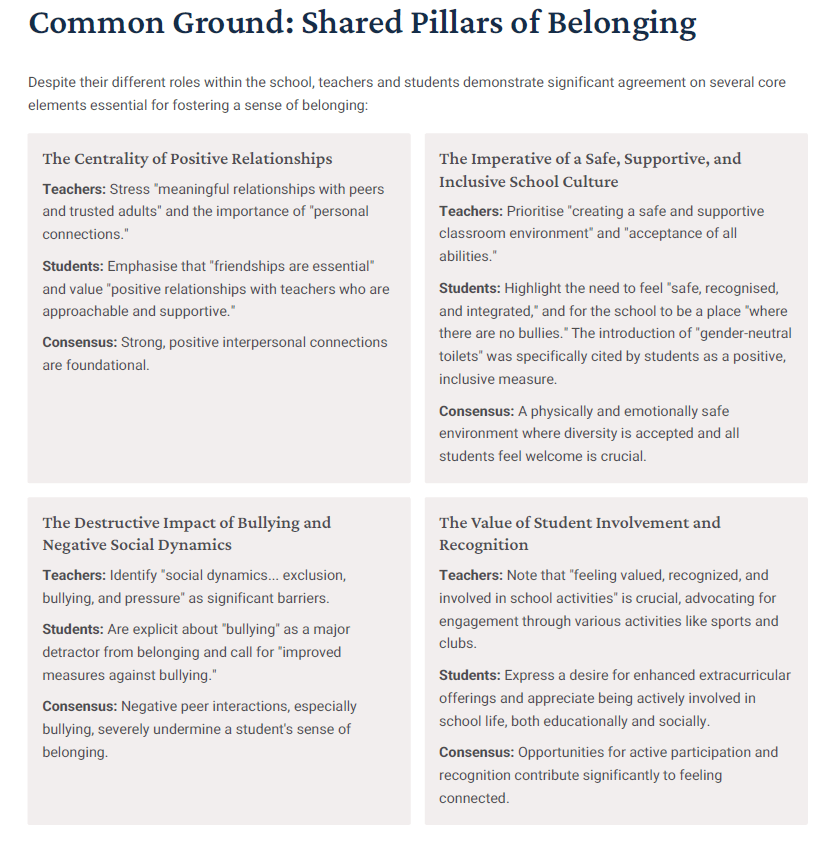
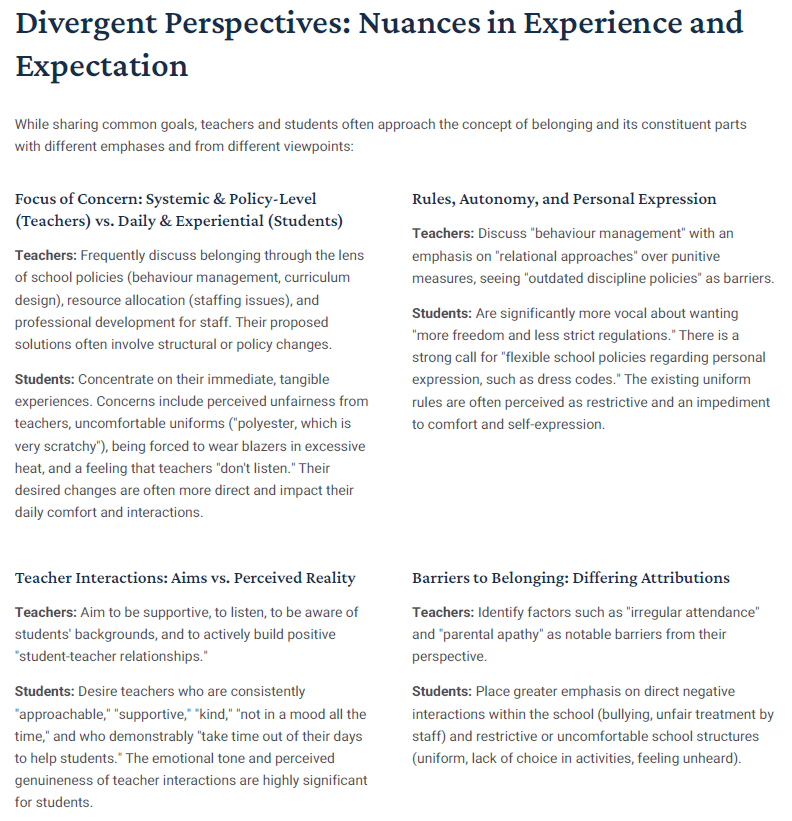
When it comes to comparing what secondary students think, compared to their teachers, the results were also interesting.
Finally, and I think perhaps most interestingly, we looked at the differences between what primary students think and what their secondary peers think.
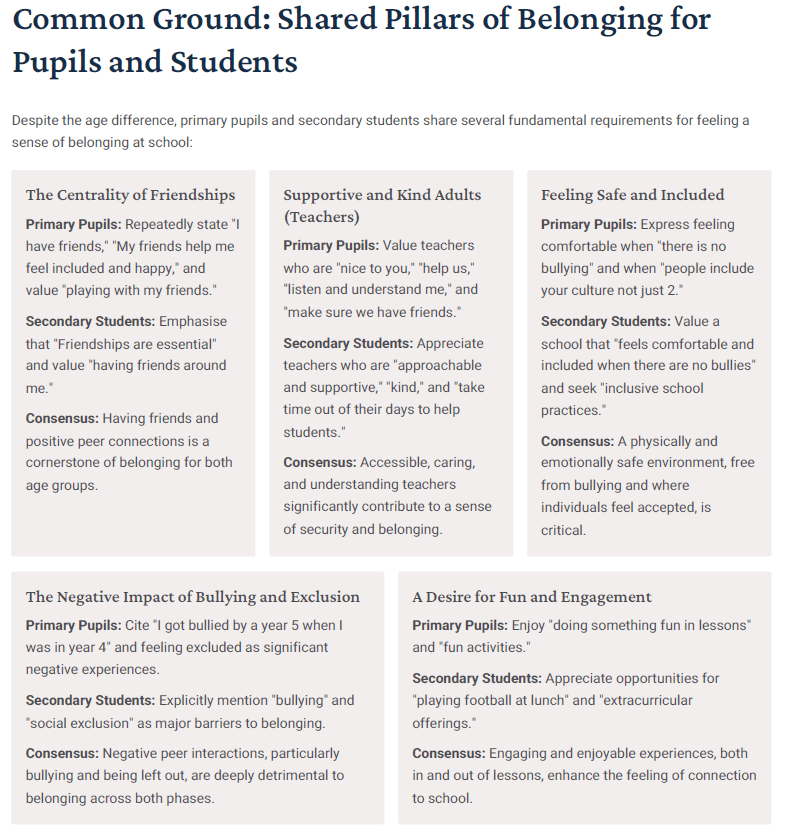
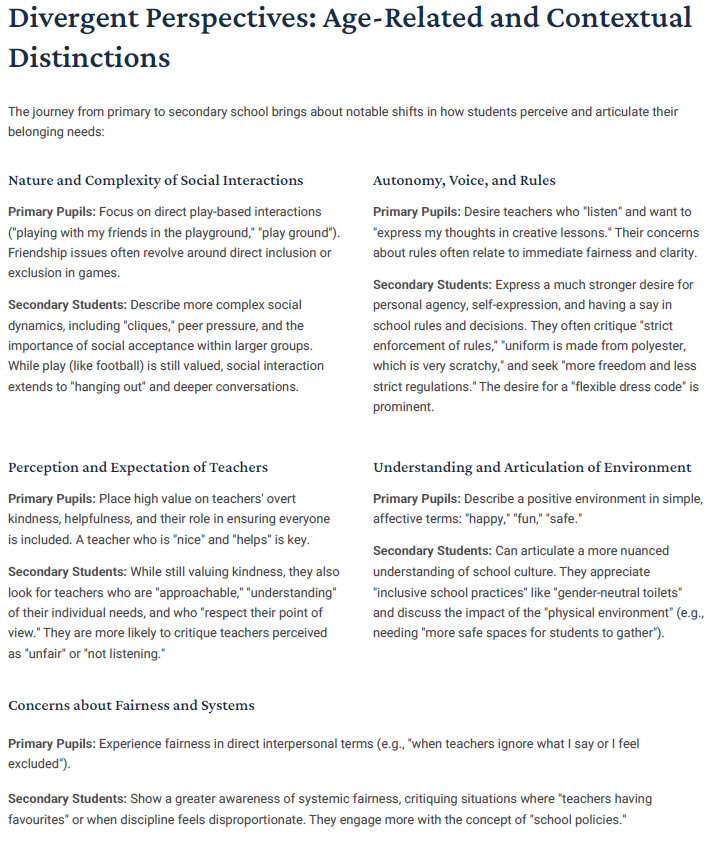
What we can see from this analysis is that, although the central themes of belonging remain the same, the subtle difference in the way that is interpreted at different ages and stages can help us to develop the right solutions and interventions for each phase, that will generate maximum impact.
Not only that, we can see the clear difference in the way teachers interpret institutional practice and the way it is perceived by students.
None of this addresses a solution, or interrogates the validity of responses. It is put out there as an initial thought piece based on a very large scale piece of research. What I know is that we must aim to achieve an education system that doesn’t leave students feeling like this….
“I don’t feel like I belong at school. The school system is sh*it they don’t do anything about bullying and the special education is absolutely horrific. Not to mention students being forced to wear blazers in boiling heat. All the staff are mean and they care more about how every one else sees our school rather then how students feel. not to mention the uninclusive school meals that use unethical and non vegan food with no options for people who deserve respect and try to save poor animals. THIS SCHOOL IS HORRIFIC.”
“I have felt like I don’t belong at school, because I’ve been bullied before by people who were in my lessons. I felt I couldn’t belong because there was no way to avoid them and they made me feel bad. The only time it stopped, was when by pure chance they moved to different classes. I had tried to speak to teachers, but they basically told me to suck it up.“
But like this:
“You can be yourself, and it will be alright.”
I will finish by once again saying a huge thanks to Anthony and Insight Genie. They have made the challenge of analysing a large amount of information so much easier.

 The Belonging Collective