There is a moment, in any organisation serious about belonging, where intent is no longer enough. Values exist. Strategy documents exist. People speak with conviction about culture and community. Yet without a shared, explicit understanding of what belonging looks like in practice, it risks becoming something we feel rather than something we do, something we believe in rather than something we can hold ourselves accountable for.
That is the moment we found ourselves in as a Trust.
We knew we wanted belonging at the heart of everything we do. Not as an initiative. Not as an additional priority. As the integrating thread that runs through teaching, leadership, governance, community and the lived experience of every child and adult. The challenge was not belief. The challenge was coherence.
Because if belonging is everything, then everybody needs to know what that looks like. And if everybody needs to know, then it must be defined, modelled, enacted and measured.
This is why we have developed our Belonging Framework.
From fragments to framework
One of the most powerful parts of this work has been the process of bringing together what already existed. Across the Trust there were strands of exceptional practice, carefully crafted strategies, deeply held values and a wide range of inputs from staff, leaders and communities. The task was not to invent belonging from scratch. It was to listen, synthesise and shape.
I am indebted to Anthony Lawton for his role in helping me assimilate this breadth of material into a single, coherent framework. His ability to hold complexity while driving clarity ensured that what has emerged is not another layer of documentation, but a unifying architecture that makes sense of what we already do and sharpens what we must now do next.
The result is a framework that begins with a simple but demanding premise:
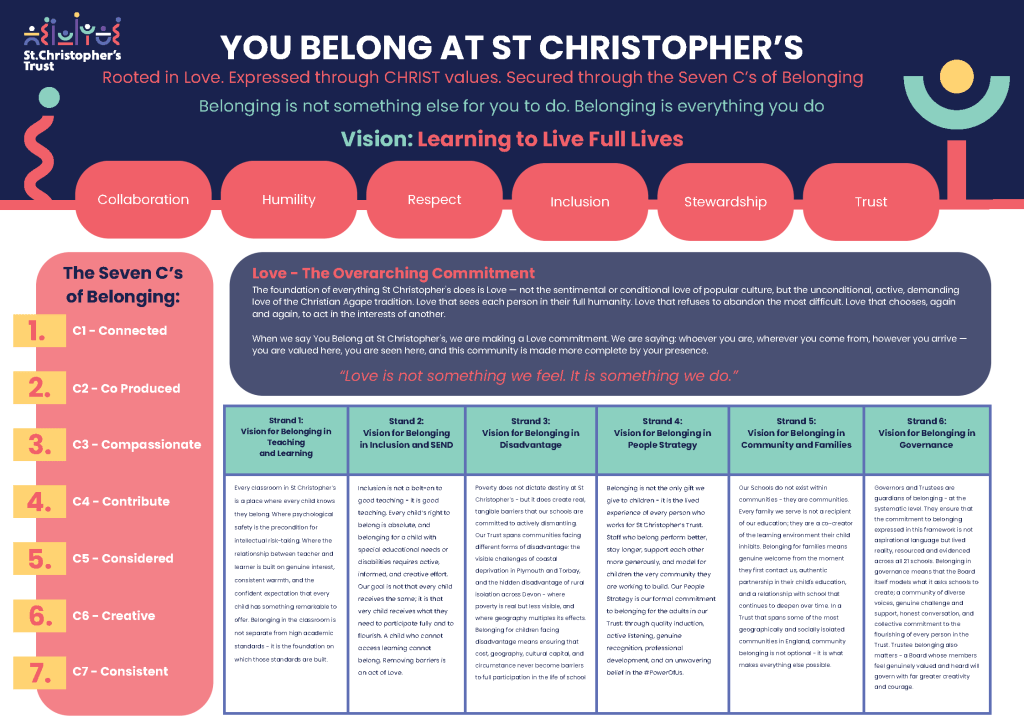
Belonging is not something else for you to do. Belonging is everything you do.
Rooted in love, expressed in action
At its foundation, the framework is rooted in Love. Not as a rhetorical device, but as an operational commitment. Love as something active, demanding and visible in decision making, relationships and systems.
This is then expressed through our values. Collaboration, Humility, Respect, Inclusion, Stewardship and Trust are not abstract ideals. They are the everyday language of belonging in action. They describe how Love shows up in practice, whether that is in how schools share expertise, how leaders respond to feedback or how we ensure dignity in every interaction.
What became clear through this work is that values alone are not enough. They describe intent but not always implementation. They tell us what matters, but not always how to do it consistently.
This is where the architecture of the Seven C’s becomes essential.
The Seven C’s: making belonging actionable
The Seven C’s of Belonging translate values into practice. They move belonging from aspiration into something observable, discussable and measurable.
- Connected reminds us that belonging is built through relationships, every interaction either strengthening or weakening trust
- Co-produced insists that voice matters, that people belong more deeply when they shape the environments they inhabit
- Compassionate places understanding before reaction, particularly in moments of difficulty
- Contribute asks a powerful question of every individual: what would be different if you were not here?
- Considered challenges one-size approaches and requires us to attend to individual need
- Creative values the expression of individual perspective across all roles and contexts
- Consistent ensures that fairness and predictability underpin the experience of belonging
These are not theoretical constructs. They are daily practices. They are the difference between a culture that talks about belonging and one that secures it.
Belonging across every strand of our work
One of the most important shifts in this framework is that belonging is not confined to a single domain. It is explicitly defined across six strands of our work.
In teaching and learning, belonging is the foundation of academic success. Every classroom becomes a place where psychological safety enables intellectual risk-taking and where every child can identify a place where they shine.
In inclusion and SEND, belonging becomes an absolute right. It requires active, informed and creative effort to ensure every child can participate fully. Removing barriers is not compliance. It is an act of Love.
In disadvantage, belonging demands that cost, geography and circumstance never become barriers to participation. The framework explicitly recognises both the visible challenges of coastal deprivation and the less visible impact of rural isolation.
In our people strategy, belonging is the lived experience of staff. It shapes induction, professional development, workload and leadership behaviour, grounded in the understanding that staff who belong create belonging for others.
In community and families, belonging reframes the relationship between school and home. Families are not recipients of education but co-creators of the environment their children experience.
In governance, belonging becomes a matter of accountability. Trustees are not observers of culture but guardians of it, ensuring belonging is resourced, measured and evidenced with the same rigour as academic outcomes.
What matters here is not just the articulation of each strand, but the consistency of structure. Each one defines vision, practice, actions and self-assessment. This is where belonging moves from narrative to accountability.
Measuring what matters
A common misconception is that belonging is too intangible to measure. The research base suggests otherwise.
Belonging is one of the most studied constructs in educational and organisational psychology, with clear links to motivation, attainment, wellbeing and retention (Cohen, 2022; Walton & Cohen, 2011). What the framework does is translate that evidence into a disciplined approach to measurement.
We already track belonging through multiple indicators: pupil surveys, staff well-being data, attendance patterns, exclusion rates, participation in enrichment and engagement from families. Each tells a different part of the story. Together, they allow us to identify where belonging is strong and where it requires attention. We will move forward in developing these measures so that we have a full and honest measure of how our framework is landing with children , and staff.
This is critical. Because once belonging is measured, it can be managed. And once it is managed, it can improve.
The role of shared language and accountability
Perhaps the most significant shift created by the framework is the establishment of a shared language.
When a teacher reflects on being strong in Consistent but weaker in Co-produced, that is a professional conversation grounded in clarity. When a leader asks how a decision impacts belonging for the most vulnerable, that is accountability rooted in values. When a trustee reviews belonging data alongside attainment data, that is governance aligned with purpose.
Without shared language, belonging remains diffuse but with it, belonging becomes something we can name, challenge and develop.
A framework, not a finish line
It would be easy to see the creation of a framework as an endpoint. In reality, it is the beginning of more disciplined work.
The framework sets out what belonging looks like. It does not guarantee that it happens.
That requires consistent practice. It requires leaders at every level to model it. It requires teams to use the self-assessment tools with honesty. It requires governance to hold the system to account. It requires us to return, repeatedly, to the central question:
Are people experiencing belonging here, or are we simply talking about it?
It is also a work in progress. As we develop, there may be new domains, new strands. I can already see a place for a new strand on communication, for example.
Seeing belonging, doing belonging
The most powerful line in the framework remains the simplest.
Belonging is not something else for you to do. Belonging is everything you do.
The work of this framework is to make that visible. To ensure that when we say belonging is at the heart of everything, everyone knows what that means, what it looks like and what they are responsible for.
Because belonging, if it is to be real, must be shared. It must be enacted. And it must be held to account.
The poster linked is just our poster, there is a deeper framework that sits behind it. If you would like me to send you a copy of our emerging framework, just drop me a message and I will it out to you.
References
Cohen, G. L. (2022). Belonging: The science of creating connection and bridging divides. W. W. Norton & Company.
Pinker, S. (2014). The village effect: How face-to-face contact can make us healthier and happier. Atlantic Books.
Walton, G. M., & Cohen, G. L. (2011). A brief social-belonging intervention improves academic and health outcomes of minority students. Science, 331(6023), 1447–1451.


